Nanda Malini Baby
2026 August 21
Janaka Samarakoon | Nice, July 21, 2026
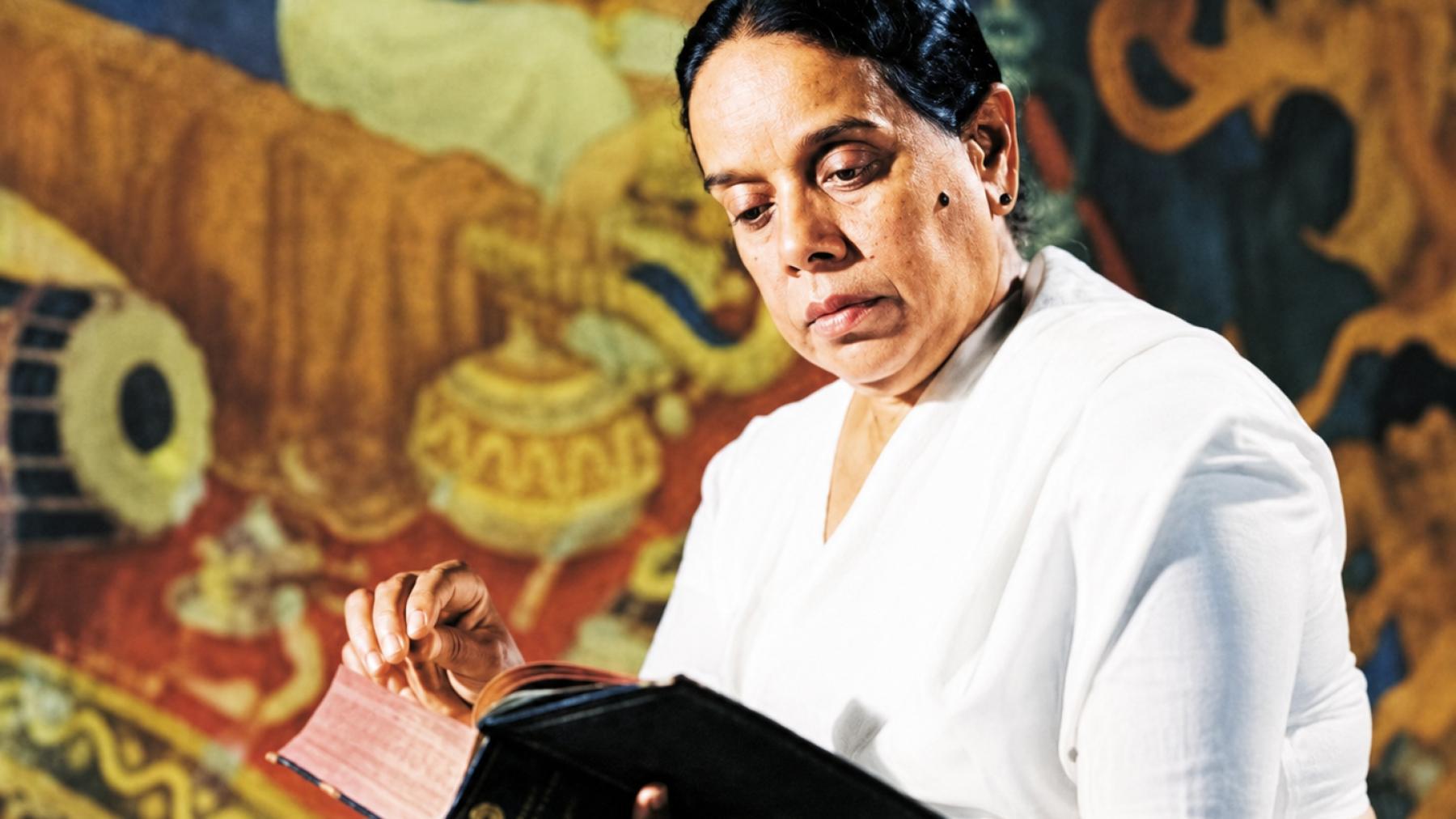
I learnt about music with her, by listening to what she was doing with it. I learnt poetry with her, by deciphering the lyrics she sang. I became aware of politics, of class, of injustice, by turning over and over what that voice was telling me — so suave a voice, though not always, for she knew how to be hard when the stakes ran higher than art and beauty. And in the end it was thanks to her that I began to open up to the world. I was five then, or maybe eight. It went on until I was seventeen, nineteen perhaps. She was my spiritual mother. She was my first Sinhala teacher. She was my imagined mentor. She was my favourite singer. She is Nanda Malini. She is no more.
It was thanks to my sister that I discovered first the beauty of her music, and then its power. My sister was ten years older than I was, which meant that I had the privilege of reading her books and listening to her music a decade earlier than I otherwise might have. I struck lucky, and I struck lucky young.
We were living in that remote village near Kurunegala. Five kilometres from town and an hour away: twenty minutes on foot along a rubble path, then cooling our heels at the bus stop, and finally the bus itself, which rarely got much above walking pace — when there was a bus at all. We had no electricity. We had a black-and-white television run off a car battery, which we were allowed to watch for about an hour a day, between eight and nine in the evening ; that was prime time : the news and the evening serial. And we had a radio-cassette recorder, which is what we called those small black-and-silver boxes fitted with tiny speakers that seemed, at the time, the height of technological sophistication.
I remember the next fact very well, because its irony became a private mythology. I did not become enamoured of Nanda Malini’s music over the FM band — there was no FM back then, only AM — nor by way of a cassette. It happened in a booklet.
There had long been in our house a very old radio set, with ivory-coloured buttons picked out in glossy jet black. Like the keyboard of a piano, I would think decades later, the day I finally saw one. And when I was smaller still, that antique object had been out of order for months, perhaps for years. Time was elastic then. I cannot measure it now. Then one day Father came home with a small National Panasonic® radio-cassette recorder tucked under his arm. For the household it was an epiphany of a sight. The precious equipment was installed in the most eminent place in our drawing room, beside the television set — for a radio-cassette recorder ranks immediately below a television, does it not?
There was only one problem. We had no cassettes. Or rather we had one, because the friend from whom Father had bought the second-hand machine had luckily delivered it with a cassette inside. A sort of bonus. I would learn later that the friend in question owned two copies of the same cassette and was more than happy to part with the spare. The cassette called itself Yaathra. It carried a beautiful photograph — very arty, I would say today; more arty than artistic — of a lady dressed in white, seated in an oruwa, a "yaathra", holding — delicately, and not playing — a zither. I remember catching sight of an enormous poster of the same photograph in the friend's house.
But it was not the music inside that cassette which struck me first. My sister played it over and over until the tape jammed in the machine, and in pulling it free we stripped the magnetic ribbon and destroyed everything it held. There had also been a booklet delivered with the radio. One might say the machine was a kind of Nanda Malini Trojan horse — which shows how prominent the singer already was. She was in her early forties and already the most prominent of all. The booklet was entitled Hemanthayedi. It was a delicately produced piece of free publicity: fine paper, careful printing, a title cut out of the cover in wonderful calligraphy, the letters opening like tiny windows through the paper, the songs elegantly laid out across the pages.
I flipped through it endlessly.
For reasons I cannot quite explain, I fell in love with that little book. I learnt all the poems — all the songs, as I would later find out — by heart. And because I had never actually heard them sung, I invented melodies for them myself. Only later did I understand that the booklet was the official companion to another album by the famous singer whose cassette we had briefly possessed.
One anecdote stays with me. I was playing a musical game with my cousins. Each of us had a set number of seconds, thirty perhaps, to sing a song. When time ran out, we had to stop dead, even if that meant being stranded in the middle of a line, or even of a word. The next contestant then had five seconds or so to come up with another song beginning with the letter on which the previous singer had been frozen. At these family contests I would triumphantly sing songs from my precious booklet, set to melodies of my own invention. Everyone would stare at me. What on earth were these blasted songs the boy was murmuring? Nobody recognised them — and of course they recognised the melodies even less, since I had composed those myself. They called them illicit. I argued they were not. But I had no proof. I particularly remember an aunt becoming irritated when she heard me singing one of the texts, which mentioned virgins (the song should be Kumari Bambasara). From her reaction, you would have thought I had uttered an obscenity.
By now I had become a die-hard Nanda Malini fan. I had hardly listened to any of her songs, but I knew at least twelve of them by heart.
Then came Pawana. It was a whirlwind of a musical experience. By then Nanda Malini had become a hardliner. The concert, which toured the island, was an act of resistance. She sang against injustice, against racial hatred, against class discrimination, and her audiences came away galvanised.
Do not be lulled by the beauty of my singing.
Listen to me, and stay watchful
— on those rickety chairs, sit firm and unflinching.
For my words are not songs.
They are the lamentations of thousands of oppressed hearts.
I never managed to attend that concert, even though she came several times to the Kurunegala Town Hall, our local ramshackle opera house with "rickety chairs". But I remember another funny thing. I was ten. It was the period when we, the pupils, were given an allowance — actual money! — by the central government to cover the cost of lunch. I went to school with a lunchbox prepared each morning by Mother, so I never had to spend a rupee of it. I kept it, and when it had swollen into a lump sum, which for me meant sixty rupees, I bought myself my first gift ever paid for with money: the two-cassette album of Pawana. It was a beautiful object. Two cassettes inside a finely made paper box the size of a paperback, with a beautiful photograph of the singer sitting cross-legged in her eternal white attire, singing as though praying to invisible powers she was calling upon to protect our island, put an end to its war and settle its injustices. I would listen to my prized object the way a Western teenager listens to Nirvana. Full volume, screaming the words along with the performer, waving my arms, imploring the Buddha, the divinities, whatever power the incantation seemed to invoke.
I am no Walt Disney baby. I am no Jackson Five baby. I am no Nirvana baby, no Doors baby. I had access to none of those pre-globalisation idols. I am a Nanda Malini baby.
The first "paper" I ever wrote — I put the word in quotation marks because, at fifteen, I fully intended it to be a paper in the lofty academic sense — was also about Nanda Malini. By then I had left Kurunegala for Kandy and entered a fancy rich-kids' school there. Within my first few days, I had the audacity to write a piece for the school journal. It was about Nanda Malini's activism and about the new genre she had, to my adolescent mind, almost single-handedly established within Sinhala culture: wirodhaakalpa gee, "songs of resistance". Today I would probably consider this particular body of her work among her weakest. At fifteen, however, I was intoxicated by those not terribly subtle lyrics and the emphatic, unmistakably local rhythms that propelled them. I remember one humiliation particularly well. I had misspelt — out of ignorance rather than carelessness — the very Sinhala term my "paper" was supposed to be defending and promoting. My loyal friend Lohan discreetly suggested that perhaps I ought to use the correct word and, with exquisite confidentiality, whispered it to me.
The article appeared in the school journal and immediately secured me a certain standing within the school community as a Nanda Malini expert. I am still sometimes considered one. I am not.
I did, however, once meet the Grande Dame of Sinhala song.
She came to our school, the same fancy rich-kids' school, set on a picturesque hill above the Kandy Lake, for a shoot. It was a new single, released by the Sri Lanka Rupavahini Corporation, on the virtues of being a good patriot or some equally edifying notion. She spent a whole afternoon and evening with us while the crew set up the entire rigmarole such a superproduction requires — the scene was to be filmed at night — and, as the uncontested Nanda Malini specialist, I was deputed to stay all of that time at her side. I was like a Delphic priestess suddenly admitted into the presence of Apollo. Or a fifteen-year-old Titanic fan catching sight of Leonardo DiCaprio on the red carpet.
Awestruck to tears, I was far more concerned with her physical comfort (Do you need water? What about tea? Are you hungry, Ma'am? A biscuit? A plantain? A bun? There are excellent buns down the hill, I can fetch you one…) than with discussing music with her. I remember telling her repeatedly how much I loved her — how much I loved her music and, above all, how much I loved her. My feelings were somewhat confused at that age.
Then, in a fit of adolescent devotion, I decided to give her something.
A friend of mine had carved a tiny statuette with his penknife that very day and, for some reason, had given it to me. It was a clenched fist, brandished. I prized it enormously and had owned it for only a few hours. And I gave it to her. I can still remember, almost word for word, the solemn little speech with which I presented it:
"I know how insignificant I am, and how insignificant this statuette is, but this is all I have, Ma'am. If you accept it, you will make me the happiest boy on earth. Please keep it."
I handed it over ceremoniously, with both hands. She accepted the "award." And, come to think of it, that raised fist might indeed have made a rather magnificent award if enlarged and cast in some precious metal.
Then we went down to the film set.
I was one of perhaps a hundred schoolchildren used as extras in the scene filmes with cranes. If that music video still exists somewhere, I must be in it.
From that day on, whenever I saw a photograph taken inside her home, the famous Music Ashramaya, I would inevitably search for my two-centimetre statuette somewhere among her many trophies, certain that she had kept my present in her cabinet. I never found it in any of them: the photographs were simply never sharp enough to reveal so small a detail.
I still have not seen the Disney classics — apart from the more recent Pixar films I have watched with my children. I am still a Star Wars virgin. I cannot sing a single Michael Jackson line by heart. That is perhaps as it should be, for I was a Nanda Malini baby. And today, I am an orphan.
Share this article