
From Sinhala to French: Translating a Way of Telling — Crossing Languages, Crossing Worlds
15 January 2026
By Janaka Samarakoon
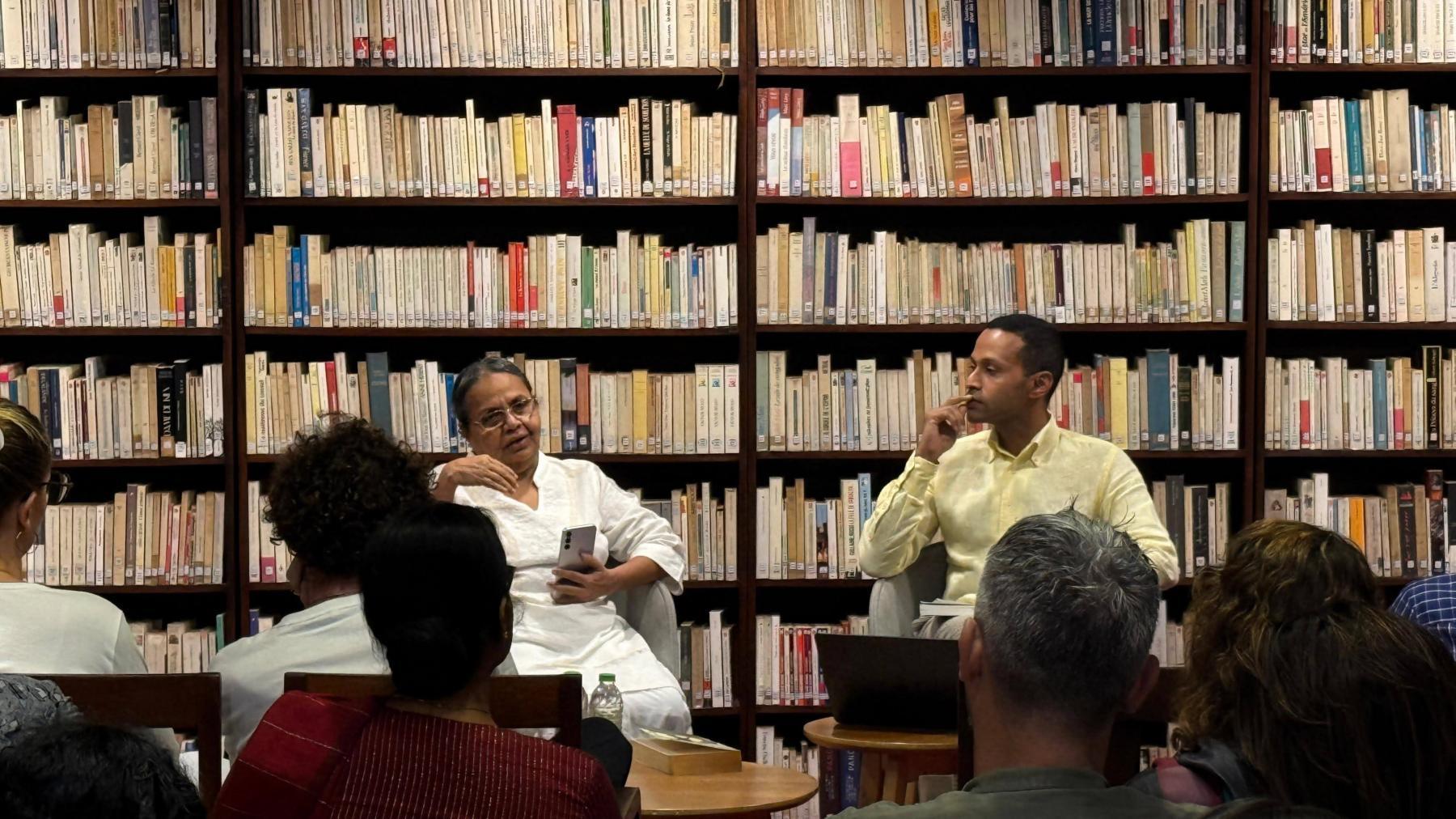
This is a lightly edited transcription of talks given at the Alliance Française de Kandy on January 4, 2026, and at the Alliance Française de Colombo on January 9, 2026.
Coming back to where it all began
Thank you to the Alliance Française de Sri Lanka for hosting this event. This evening means a great deal to me, because my own story is intimately connected to this institution. It was here, in the year 2000, when I won a poetry competition, that my journey toward France first began. The prize was a stay in Provence, right in the middle of the Festival d’Avignon. Living such an experience at the age of twenty changes your life. It changed mine. So, to come back here today, with my translation under my arm, feels both deeply meaningful and deeply moving.
And I also want to say a very special thank-you to Sunethra, for allowing me to translate her wonderful book — and above all, for trusting me completely. She gave me total freedom, never interfered, and let me carry the project forward in my own way. That kind of trust between an author and a translator is rare, and I’m deeply grateful for it.
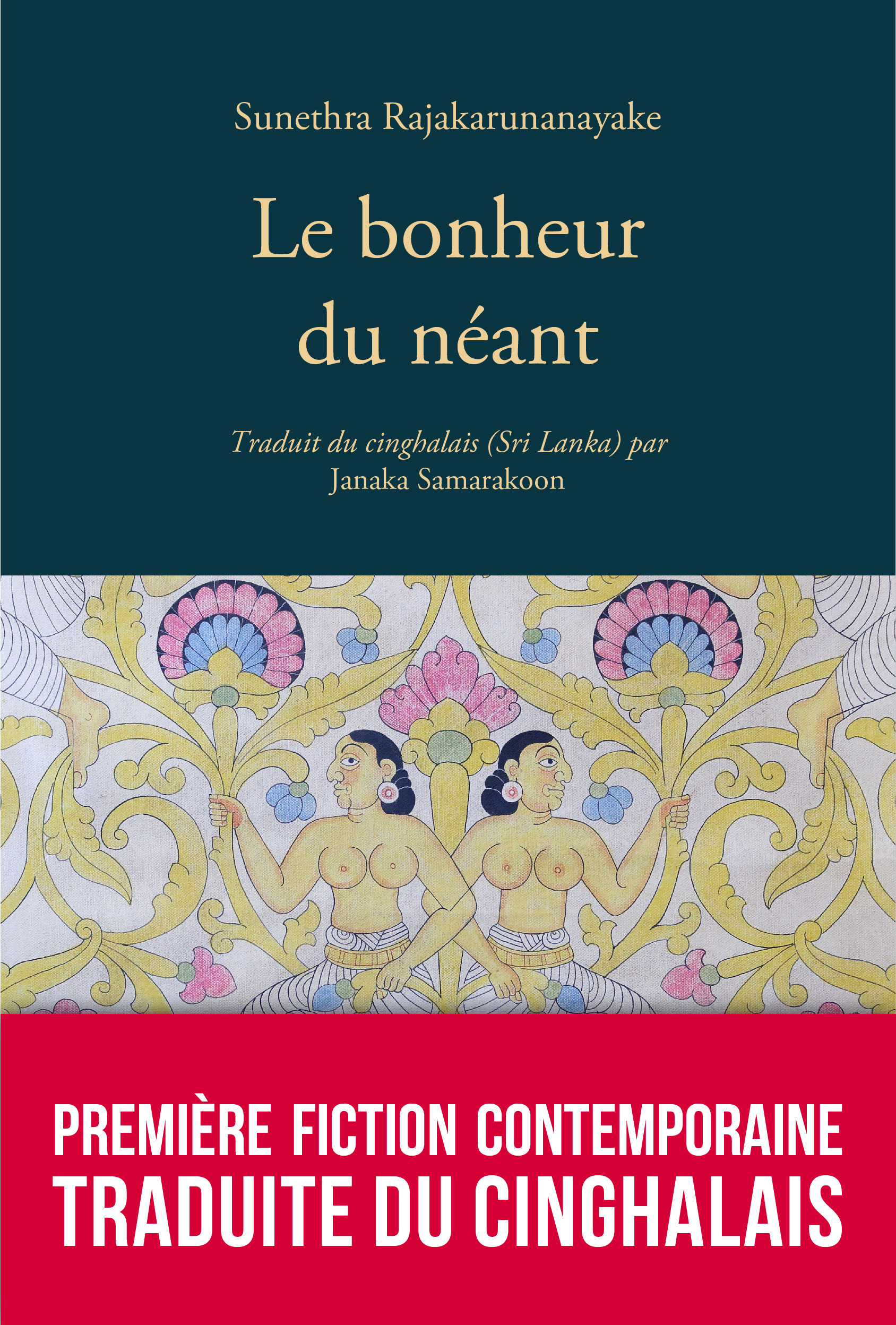
The first contemporary work of fiction translated from Sinhala (Sri Lanka) to French.
Set in a tropical village in the conformist Sri Lanka of the 1960s, this novel follows Nirmala, a young woman whose first experience of love overwhelms, blinds, and ultimately breaks her. Through a succession of encounters — chosen, endured, or accidental — she slowly frees herself from social constraints and from love’s confining power, transforming it into a path of liberation.
Inspired by ancient Eastern texts and shaped by ellipsis, this is the story of a woman’s quiet emancipation. As she crosses the boundaries of a tightly corseted culture, Nirmala undertakes a subtle yet profound inner revolution.
How this book first entered my life
I discovered this novel when I was nineteen. Back then, whenever an exciting book came out, I would go from Kurunegala to Colombo in person — easily a three-hour journey — buy several titles, and bring them back home. Even the trip itself was part of the pleasure of reading. And when this novel was released, I did exactly that: I bought it immediately and devoured it in a few hours.
Before that, I had already read Sunethra’s first published novel, Sandun Gira Gini Ganee, which I adored. At the time, it was a real revelation. The way she rooted her story in a very strong regional identity — through landscape, vocabulary, rhythm, voice, even a kind of almost audible orality — was really exciting. The book was full of Sinhala words specific to that region, often unfamiliar to us, and even what some people called “strange grammar.” This artistic license, these fully assumed aesthetic choices, are precisely what her detractors would go on to reproach her for throughout her career.
I would love to translate Sandun Gira one day. It’s a perfect novel of formation — a Bildungsroman — a South Asian, post-colonial and feminist re-reading of Great Expectations. But I also know how hard it would be to carry that particular reading experience into a Western language without losing a lot of its flavour. Because that flavour isn’t just in what is said — it’s in how Sinhala itself breathes in that region.
So that’s the background in which I discovered the book I eventually translated. And what a discovery it was.
A book that opened the world to me
If Sandun Gira is deeply rooted in a rural, regional world, this novel felt like its opposite: a much wider horizon, a global perspective. At the dawn of the new millennium, many of us had big hopes about globalisation — especially with the arrival of the internet — as if a new world was opening, promising some kind of happy, borderless brotherhood. In that spirit, Nirmala’s freedom, her journey across the world becoming a journey of the self, spoke to me very deeply.
I easily pictured myself as a backpacker on dusty roads in Bihar, or sitting in a beautiful café overlooking San Francisco Bay. This book gave me the urge to go elsewhere — to look for fulfilment in otherness, in the unknown.
What it really means to translate (to me)
Now, a few words about the translation itself.
Yes, it took a long time. Seventeen years. And yes, it was demanding. I rewrote the text many times. But every rewrite was not just an attempt to move Sinhala into French word by word. It was an attempt to recreate — in a very different language — the experience I had as a reader, as someone who grew up inside Sinhala.
So when I talk about fidelity — or about my intellectual integrity toward the source text — I don’t mean a literal sequence of words and sentences. I mean the narrative experience those words produce: the movement of the story, its rhythm, its tonal balance, its emotional intelligence, and also its social and political background.
Translating a novel is not only about changing languages. It’s also about changing ways of telling — without changing what is being told.
Two languages, two ways of organising reality
Very early on, I realised that the real difficulty would not be lexical. It would be narrative. It would be about how a language organises voice, time, space, and interiority. French prose has many little tools — and the French readers have learned to expect them — to connect events, to suggest movement, to guide interpretation, and to weave speech and thought into the flow of the story. Sinhala often moves differently: more by exposure than explanation, more by situation than by commentary.
In this context, translation became a sequence of situated decisions, taken case by case: when to adopt French narrative conventions (localization*), when to resist them, and when to engage in a form of "mediated foreignization"*, allowing the alterity of the source text to remain perceptible within the French language — without ever flattening what gives the original its vitality, or allowing opacity to persist.
Space, time, and the architecture of meaning
One of the first tools I used extensively was the integration of dialogue into narrative flow. Sinhala often lets speech stand on its own, relying on context. French, by contrast, expects dialogue to be framed — through tags, rhythms, and tonal cues. Using “he said,” “she asked,” or more nuanced verbs allowed me not only to identify speakers, but to orient the emotional and narrative movement of the scene.
— Oh! Nirmala, vous êtes bien la seule à ne pas m’engueuler, s’étonna le coordinateur du congrès, réalisant qu’il avait omis de régler mes honoraires.
— Ne vous en faites pas, ce n’est rien. L’oubli est humain.
Je répondis avec philosophie.
[p. 6]
Another central aspect was spatial organisation. In French, I made places, movements, and bodily positions visible: corridors, doors, rooms, sofas, balconies. These are not decorative details — they allow the reader to inhabit the scene, to grasp social relations, emotional stakes, and power dynamics.
Puis je descendis deux étages, là où se trouvait la chambre de Ravy. Indécise, je passai deux ou trois fois devant la porte, affichant le numéro que j’avais pris soin de mémoriser. Était-il encore seul ? Peut-être que sa Ramanie était à son chevet… À la troisième tentative, je me résolus à frapper à la porte, sans trop réfléchir. Je me surpris même à chercher des excuses pour justifier les deux heures écoulées depuis mon appel.
— Entrez !
J’ouvris doucement la porte qui n’était pas fermée à clef. Ravy était dans son lit, la télé fixée au mur devant lui allumée.
— Toi ?
Surpris, il sauta du lit tout en appuyant sur la télécommande. Je m’immobilisai au milieu de la pièce, ne sachant vers quelle direction me diriger. Ravy portait un bouc soigneusement taillé. Il avait grossi un peu et ressemblait à un vrai père de famille. Il était plus beau que jamais.
Il s’approcha de moi, les bras tendus.
— J’étais sûr que tu ne repartirais pas sans venir me voir.
Il me débarrassa des magazines et des livres que je portais, me prit délicatement par le coude et me guida jusqu’au canapé rouge, au fond de la chambre. Il dégageait un parfum d’après-rasage.
[p. 47]
This spatial clarity works hand in hand with temporal structure. French’s multiple past tenses allow gestures, movements, and events to take on precise narrative weight. Space and time together form an architecture of meaning.
Au milieu de tout ce chaos, je continuais de penser à Ravy. Je me disais que si cela m’était arrivé avec lui, je me serais probablement donnée la mort pour lui laisser la possibilité d’épouser une femme équilibrée.
[p. 40]
In the Sinhala text, by contrast, space and time are often handled elliptically. Much is left implicit, because readers share a cultural world in which such cues are already legible. French readers, shaped by the Realist and Naturalist tradition from Stendhal to Zola, by contrast, expect narrative space to be organised, fully navigable, and therefore readable — all the more so in an unfamiliar setting like the one depicted in this novel. As the translator, I felt compelled to build that architecture, not to betray the original’s spirit, but to support it more fully.
When sociology becomes part of the story
And then there is sociology, which is absolutely central to this work. Many scenes rely on deeply structured social realities that are only lightly sketched in Sinhala. This brevity fully works within the novel because Sinhala readers already know the social codes, the hierarchies, and the unspoken rules.
In French, however, these things cannot be taken for granted. So, in order to preserve their emotional and dramatic weight, I sometimes had to unfold what was implicit — through small asides embedded directly into the prose, or by naming a psychological or ethical state, by showing how a gesture or a hesitation carries social and normative meaning that may not be obvious to a French reader. Not to add meaning, but to ensure that an indispensable social reality remains perceptible.
[…]Au milieu de tout cela, et à cause d’une maladresse de ma part, ma mère parvint à mettre la main sur une lettre de Ravy que j’avais bêtement cachée sous mon oreiller. Le scandale éclata au grand jour au sein de la famille ! J’étais convaincue que je passerais le restant de ma vie entre les quatre murs de ma chambre…
Après la découverte de cette preuve irréfutable de ma perversité morale, arborant une grimace qui donnait à son visage un air lugubre, ma mère se mit à faire les cent pas dans la maison. Elle virevoltait ensuite, comme une possédée, dans le jardin. Sa détresse était si grande, et ma trahison si inattendue, qu’elle ne prononça pas un mot de la journée. Ce silence, inhabituel chez elle qui élevait souvent la voix pour un rien, me parut de très mauvais augure. Dans d’autres circonstances, elle aurait déjà saisi la canne pour me donner une bonne leçon.
[p. 26]
—
Je crois que mon éducation ultra-conservatrice, suivie de ce mariage arrangé, n’avait pas favorisé l’épanouissement de ma vie sexuelle. Je n’avais ni l’envie ni la capacité de répondre à ses désirs. Ne réagissant plus à rien, mon pauvre corps finit par devenir une branche morte, incapable de s’animer.
[p. 41]
Rather than interrupting the narrative with external explanations — which would have struck me as an admission of narrative failure, a position I acknowledge may be debatable — I chose to integrate these elements directly into the fabric of the story: through interior voice, gestures, postures, and the organisation of space.**
Après m’avoir installée sur le canapé, il retourna à son lit, arrangea les oreillers et s’assit, adossé à la tête de lit. Sa chemise de lin, déboutonnée jusqu’au milieu de la poitrine, et son sarong aux couleurs flamboyantes, typique de la marque Barefoot, lui donnaient un air prospère et séduisant. Je ne l’avais jamais vu en sarong auparavant, car les hommes ne mettent plus ce vêtement traditionnel que dans l’intimité de leur maison. Pourtant, à Colombo, le sarong faisait son grand retour, prisé lors des mondanités de la haute société.
Sur la table de chevet, un bouquet de roses touffu, accompagné d’une carte de vœux.
[p. 48]
Sociology was not explained — in line with the theoretical recommendations of Gayatri Chakravorty Spivak, for whom the use of notes tends to turn a living literary work into a mere sociological or ethnographic document. Instead, it was staged. I intended it to function as a discreet form of mediation.
A regime of meaning
So across all these techniques, translation appears not as a neutral transfer, but as a series of situated decisions, taken in context, case by case. And in every complex narrative situation, the same questions arose: should I make the implicit explicit, should I merely suggest it, or should I deliberately leave it unsaid? Am I over-interpreting? Am I ironing out some of the book’s formal singularities? Or, on the contrary, are some poetic liberties that make perfect sense in the original precisely what would confuse a French reader if they were kept as they are?
For me, as a translator who became a mediator in this particular endeavour, fidelity did not mean reproducing forms. It meant preserving a regime of meaning — narrative, cultural, and social.
Translating this novel was a way of learning how to tell differently. It involved shifting a reading contract from one cultural context to a completely different one, without ever betraying what makes the original book what it is.
Further readings
- Culture in Translation: Shyam Selvadurei’s Funny Boy in Sinhala and French by H.S.M.M. Jayawardena
- Translation of Emotions and Typically French Contexts into Sinhala: Analysis of the Sinhala Translation of Jean-Louis Fournier’s Novel, Où on va, papa ? by Niroshini Gunasekara
*Domestication / Foreignization : The notions of domestication and foreignization were formulated by the American translation theorist Lawrence Venuti. Domestication refers to a translation strategy that adopts the linguistic and narrative conventions of the target language in order to make the text immediately fluent and familiar to the reader. Foreignization, by contrast, seeks to keep the alterity of the source text perceptible, allowing the reader to sense that it originates from a different cultural and linguistic world. This does not imply exoticism or opacity: in practice, these two approaches do not exclude one another but exist in tension. Literary translation consists precisely in negotiating this tension, sentence by sentence, according to the demands of the text and of reading.
**On this point, see also Umberto Eco, Dire presque la même chose. Expériences de traduction, Paris, Grasset, 2007 (orig. ed. Dire quasi la stessa cosa, 2003). Eco shows that translating often involves saying things differently — or even saying more — in order to produce a comparable effect of meaning in the target language, particularly when cultural or contextual implicits are no longer shared. The aim is not to add meaning, but to shift how meaning is carried, so as to preserve intelligibility and the experience of reading.
Partager cet article

« La nuit tombe sur Suriyakantha… »
09 March 2026
Communiqué : Le Centre Suriyakantha lance son premier audioguide
25 September 2025
