
When Symbols Collide— Blackface, Buddha Images, and the Asymmetry of Tolerance
23 January 2026
By Janaka Samarakoon
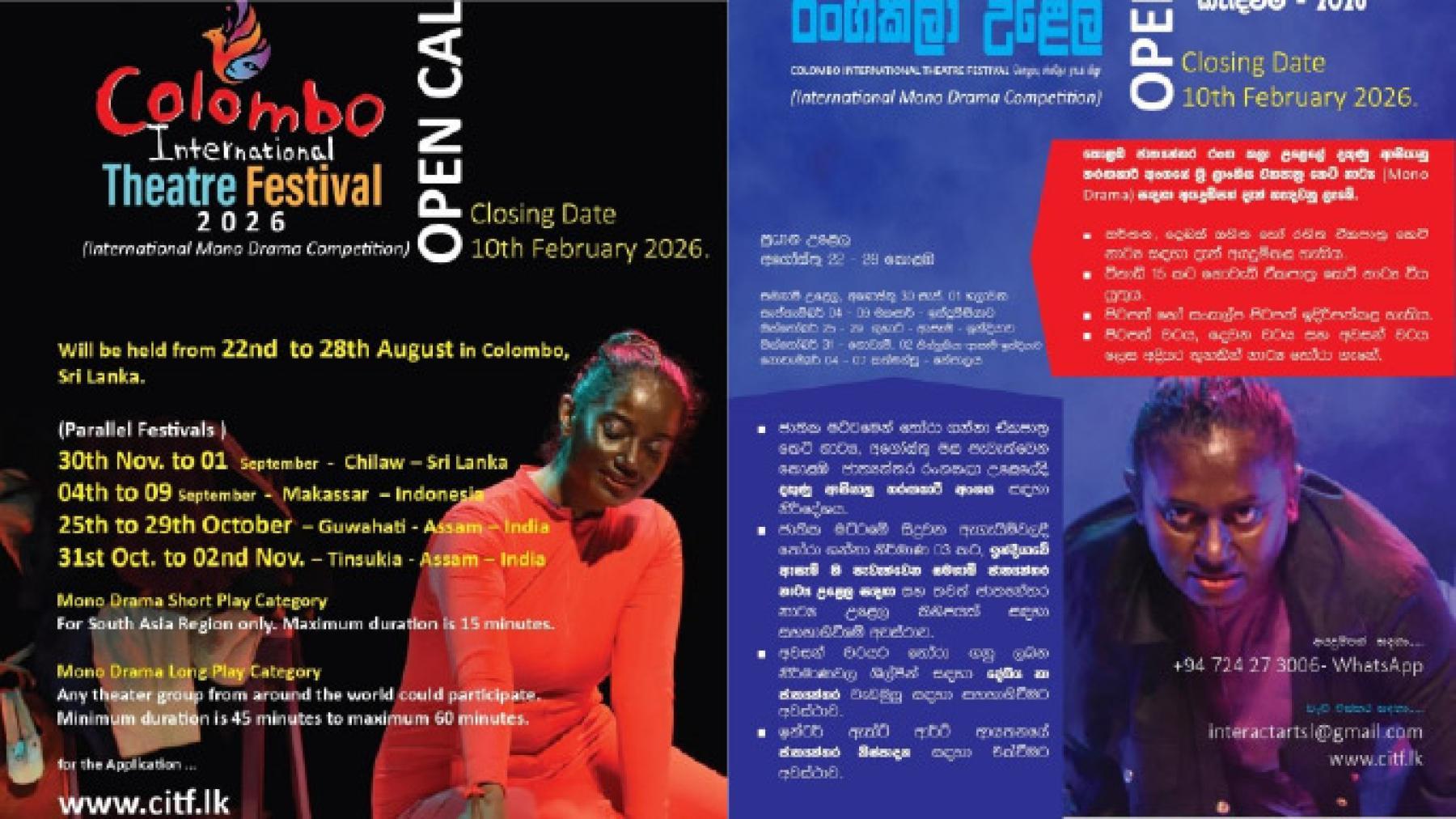
A series of images has been appearing repeatedly under my nose lately while scrolling through my Facebook timeline. They show Sri Lankan performers with darkened skin, promoted by its foremost international theatre festival. The first time, I noticed them but moved on to the next attraction that popped up. The second time, I shared my concern with my cousin; we had a nervous laugh together and let it go. The third time—well, the third time I decided to write this piece.
From the Western context through which I access my Facebook timeline, the reaction to such images would almost certainly be immediate and explosive: public outrage, accusations of racism, demands for withdrawal or apology. In Sri Lanka, where these images were posted, they passed without any scandal. For someone fully inhabiting Western symbolic modernity, this disparity can be disorienting. Living between two worlds, I find this situation revealing.
Seeing these images and reflecting on what they reveal to me, another seminal image came to mind—one far less visible today, yet deeply embedded in Sri Lankan collective memory. In 1994, a foreign visitor was photographed sitting on the lap of a Buddha statue at Dambulla. From a Western perspective, such a gesture would likely register as brainlessly careless or naïve—tasteless, for sure—but hardly existentially offensive. In Sri Lanka, however, the reaction was swift and severe. The episode received wide publicity, led to a ban on photography within the temple, the confiscation of film rolls, and the ritual washing, repainting, and re-consecration of the statue.* Even in today’s casual conversations, the incident can still surface as an irrefutable sign of the West’s moral decline—or, more bluntly, of its perceived absence of morality altogether.
At first glance, these two moments might appear as moral opposites. Looked at more closely, they reveal something more structural: the collision of symbolic worlds governed by incompatible moral grammars. It is an issue I find myself easily entangled in as well, as a Sinhala–French translator navigating between these spaces.
In Western societies, blackface is no longer a neutral theatrical technique. It is a historically saturated sign, inseparable from minstrel traditions, racial caricature, and the long history of humiliation tied to slavery and segregation; its meaning has become non-negotiable. Intention—whether sincere or naïve—no longer mitigates its effect; the sign alone convicts.**
Yet this stance is not universal—or so I came to understand upon seeing these images circulate.
In Sri Lanka, there is no equivalent historical genealogy around this practice: there is no tradition of minstrel performance, no collective memory of racial mockery staged by a dominant white (sic) population, and no automatic association between darkened skin on stage and racial violence. What a Western viewer immediately reads as “blackface” is locally decoded as theatrical stylisation, character typification, or an aesthetic or technical choice. The shock does not arise from ignorance or moral failure, but from the fact that the same visual sign belongs to two radically different symbolic worlds.
It is here that the asymmetry of tolerance becomes visible. In the theatrical case, Sri Lanka implicitly asks the West not to judge local practices by Western historical categories, insisting on contextual understanding and symbolic difference. In the Dambulla case, no such latitude is extended in return. Intention, ignorance, or cultural distance are declared irrelevant. The symbol is non-negotiable. This is not hypocrisy in the banal sense, but an assertion of symbolic sovereignty. Each culture seems to treat its own wounded or sacred symbols as absolute, while expecting others to relativise theirs. In practice, tolerance is rarely symmetrical; it is demanded more often than it is granted.
In postcolonial contexts, this dynamic is often intensified. Symbols that were historically misunderstood, dominated, violated—or perceived as such—tend to become strongly protected and less open to contextual interpretation. This defensiveness is understandable—sometimes even necessary. Yet it quietly suspends the very principle of contextual understanding that is invoked elsewhere. The result is not dialogue, but parallel moral absolutisms that coexist without translation.
The lesson to be drawn from these two images is neither relativism nor moral indifference. It is the recognition that symbols do not travel with their meanings intact. What is required is not immediate outrage, but symbolic translation: an effort to understand what world renders a gesture intelligible, what world renders it unbearable, and who is being asked to yield symbolically in the encounter. The real danger is not offense itself, but the belief that a single moral grammar governs all symbolic worlds. To live between them, as some of us do, is uncomfortable—but it also offers a position from which this complexity can be more clearly seen.
—
* Ananda Abeysekara, “Politics of Higher Ordination, Buddhist Monastic Identity, and Leadership at the Dambulla Temple in Sri Lanka,” Journal of the International Association of Buddhist Studies 22, no. 2 (1999): 255.
** Laurent Carpentier, « À la Sorbonne, la guerre du “blackface” gagne la tragédie grecque », Le Monde, 27 March 2019.
Partager cet article
« La nuit tombe sur Suriyakantha… »
09 March 2026
Communiqué : Le Centre Suriyakantha lance son premier audioguide
25 September 2025

Extraits : Le bonheur du néant, livre traduit du cinghalais
17 January 2025